

Investing in currencies can be very profitable. Currencies fluctuate, generally, when the US dollar is strong , most other currencies are weaker. Countries like Canada and Australia are heavy commodity based economies. This means that those currencies do well when commodities are rising.

Investing in currency involves buying the currency of one country while selling that of another. This is done through the foreign exchange market, or ‘forex.’

Forex trading always happens in pairs. For a transaction to be complete, one currency has to be exchanged for another. For example, you might buy US dollars and sell Euros or vice versa. While you could technically exchange any foreign currency that’s traded on the market exchange for another, it’s more common to trade using pre-establishing pairings.

Forex trading attempts to capitalize on fluctuations in currency values. It’s similar to trading stocks. You want the currency you buy to increase in value so you can sell it at a profit. Your profit tied to the currency’s exchange rate, which is the ratio of one currency’s value against another.

Using Exchange Traded Funds (ETFs) to trade currencies

While any investor can trade currencies through a Forex brokerage, they can also use Exchange Traded Funds to easily trade currencies; as easy as trading any stock.  With currency ETFs, you can invest in foreign currencies just like you do in stocks or bonds. These instruments replicate the movements of the currency in the exchange market by either holding currency cash deposits in the currency being tracked or using futures contracts on the underlying currency.

Either way, these methods should give a highly correlated return to the actual movements of the currency over time. These funds typically have low management fees as there is little management involved in the funds, but it is always good to keep an eye on the fees before purchasing.

Here are a few some samples of ETFs that trade global currencies. Note there is an ETF for most global currencies.

US Dollar – UUP.NYSE
Euro – FXE.NYSE
Japanese Yen – FXY.NYSE
British Pound – FXB.NYSE
Canadian Dollar – FXC.NYSE
Swiss Franc – FXF.NYSE
Chinese Yuan – CYB.NYSE

It is also possible to trade leveraged currency ETFs. For example, our subscribers have profited greatly by using the EUO ETF which is a 2X short Euro ETF.

Note that with the US dollar being the world reserve currency, we typically see an inverse relationship between the US dollar and other currencies. For example, when the US Dollar is strong, most currencies underperform.

The Trend Letter covered global currencies in each of its weekly reports.

Market Notes – April 28/22

US stocks ended sharply higher Thursday, led by technology shares as markets continued a comeback from steep losses earlier this week. This gain was in spite of the news that the US economy   unexpectedly contracted at the start of 2022 for the first time in nearly two years as lingering supply chain imbalances, inflationary pressures, and war in Eastern Europe weighed on growth. First-quarter US gross domestic product (GDP) fell at a 1.4% annualized rate after a 6.9% pace of growth at the end of 2021.

The bad news is good news logic here is that the Fed will be less likely to aggressively raise rates if the economy is heading toward a recession.  The other spark for the markets was the anticipation for Apple’s earnings, which came in positive after the close.


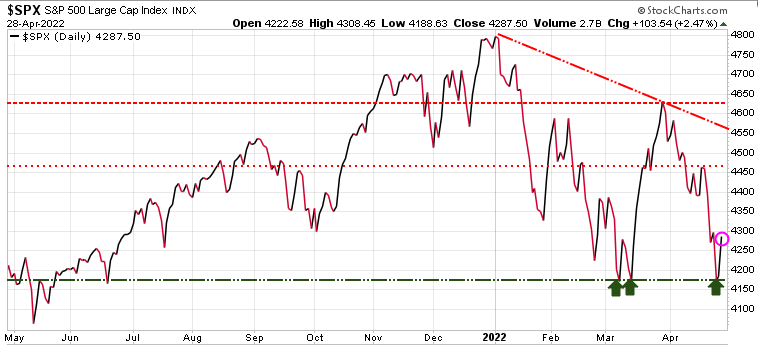
As we highlighted in Tuesday’s Today’s Charts, investor sentiment had gotten very negative (bearish) and suggested that we would see a relief rally.  Right on schedule, starting Wednesday we saw the markets rally, and then today had a gonzo spike.

The key support for the S&P 500 was the 4173 level which held the previous two times it was tested (green arrows). It held again this week, which triggered this relief rally which should test near-term resistance at 4465 (light red dashed horizontal line). If it can push through that level, then the next resistance is 4630 (next red dashed horizontal line).
Trend Letter market analysis and financial insights for investors, highlighting upcoming trends and economic predictions for strategic decision-making.

The S&P 500 has seen a series of lower highs and lower lows, so until it breaks out of that trend we need to be cautious here. The 4173 remains near-term support and if that level gets taken out, then we are in for a deeper correction, potentially much deeper.
SPX daily chart showing stock market trend analysis with moving averages, resistance and support levels, highlighting recent fluctuations and key points for investor insights.

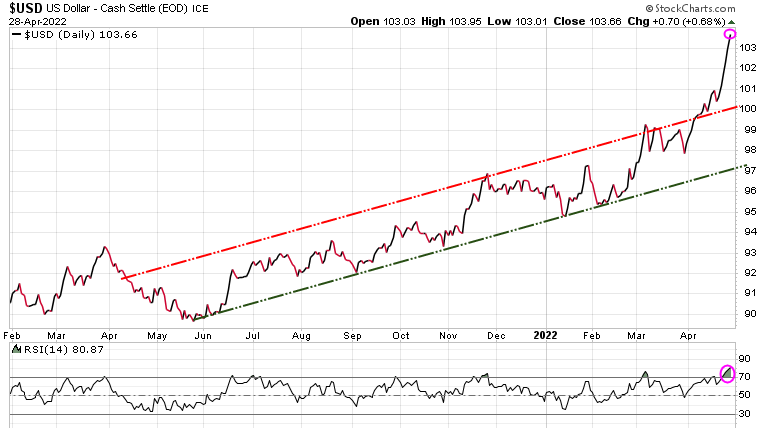
The US dollar has been on a parabolic tear this year. With Exchange Traded Funds (ETFs) it is very easy to trade currencies, just as easy as trading any stock. Unfortunately, most investors miss these opportunities.  Trend Letter uses these ETFs and currently has a leveraged short Euro trade that is up over 32% right now.
109. A line chart illustrating the US Dollar cash settlement trend, showing steady growth from February to April 2022, with marked resistance and support levels, ideal for investors and market analysts.

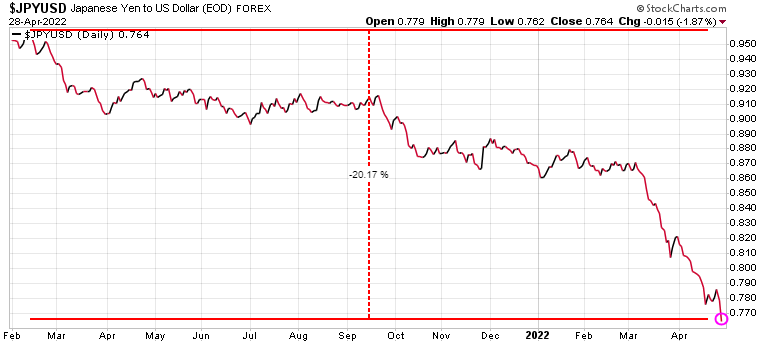
The Japanese 10-year bond yield has been negative until just recently, and even today only pays 0.21%. The US yield is 2.82% (Canada is 2.78%), so Japanese investors are pouring into US bonds, meaning they are converting Yen for $US. As a result, the Yen is getting hammered, down over 20% this year.  A weak Yen drives up import costs, especially energy and food.
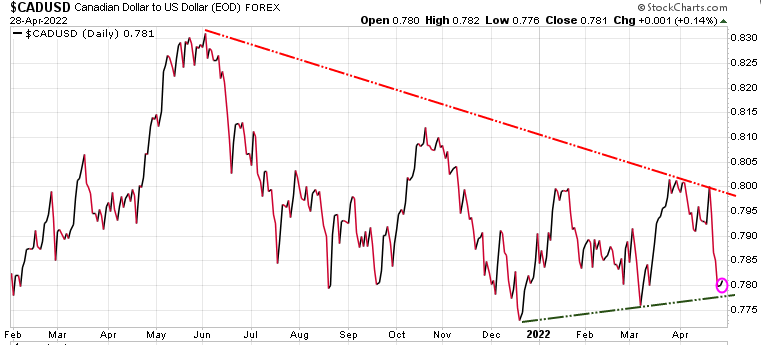
After hitting .83 in early June thanks to energy and commodities, the Loonie has not been able to maintain that strength due to the massive strength in the US.
Stay tuned!